
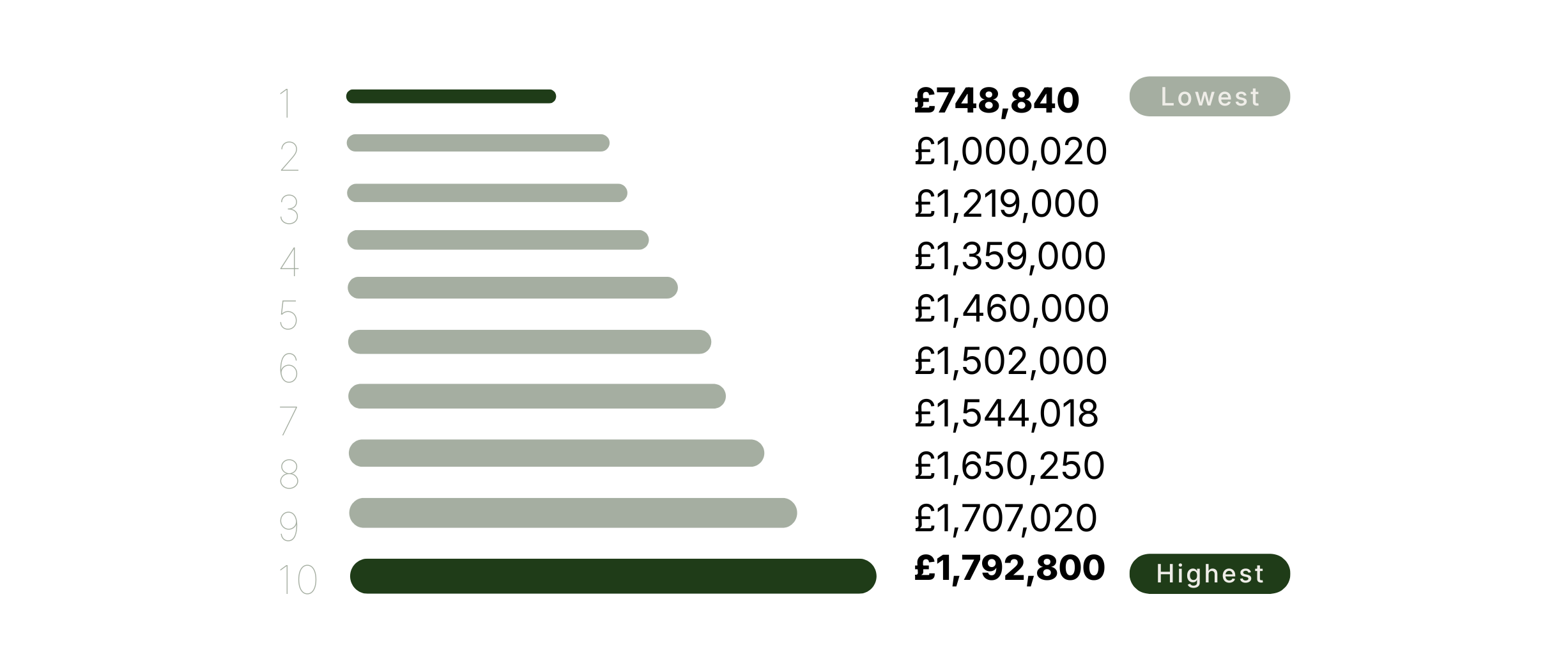
The Biodiversity Net Gain (BNG) market has evolved rapidly over the last 12 months. This time last year there were approximately 90 habitat banks registered on the national register. Today, there are 366 registered sites.
As supply has increased, average prices have undoubtedly softened. However, one of the most striking observations I have noticed on the ReVerte platform is that significant pricing variation remains across the market. In some cases, quotes for seemingly comparable units can differ by tens of thousands of pounds.
So, why does such a disparity still exist?
The current market
The majority of the market appears to be converging around a relatively consistent pricing range.
Across the ReVerte platform, average pricing currently sits between £17,000 and £22,000 per unit, depending on habitat type and location. This is broadly in line with what many developers are budgeting for and what most habitat banks appear willing to transact at.
As the market matures, this range is increasingly becoming the benchmark against which both buyers and sellers assess value.
However, averages only tell part of the story.
The Higher Outliers
While much of the market is gravitating towards the middle ground, a number of operators continue to maintain significantly higher prices.
Interestingly, this does not appear to be driven by a lack of awareness of market conditions. In conversations with several suppliers, many acknowledge that pricing has softened but remain comfortable holding firm.
The reasoning is relatively straightforward:
BNG agreements typically run for 30 years. Many suppliers therefore view the current market conditions as a short-term phase within a very long-term investment horizon. Rather than discounting heavily today, they are prepared to wait for supply and demand dynamics to settle and for the market to establish a clearer long-term value.
There is also a growing discussion around unit quality and integrity.
Some providers are going significantly beyond the minimum standards required to create and manage habitats. This often results in higher establishment costs, more intensive monitoring, greater ecological oversight and enhanced long-term outcomes.
Whilst the statutory BNG market does not currently place a significant premium on these additional measures, some operators believe that higher-integrity projects may become increasingly attractive to corporate natural capital buyers and voluntary biodiversity markets in the future.
but for some, “battening down the hatches” and waiting for the market to find its true value may prove to be a wise approach.
The lower outliers
At the other end of the scale, one phrase keeps cropping up:
Cash is king.
Establishing a habitat bank is expensive. By the time baseline surveys, legal agreements, registration fees, habitat creation and establishment costs have been accounted for, significant upfront investment is required.
Many operators are therefore willing to accept lower prices in exchange for securing early transactions and generating much-needed cash flow.
Another important factor is operational structure.
Many owner-operated habitat banks already possess the machinery, equipment and workforce needed to deliver habitat management. For these businesses, BNG can effectively utilise existing resources, meaning incremental management costs are relatively low. In contrast, larger corporate organisations are often more reliant on external consultants and third-party contractors, creating a higher cost base that inevitably needs to be reflected in their pricing.
What does this mean for buyers?
The wide range of pricing currently available presents both opportunities and challenges for developers.
Cheaper does not automatically mean better value, just as higher prices do not necessarily guarantee superior outcomes.
Factors such as location, trading rule compliance, spatial risk multipliers, delivery track record, habitat quality, contract terms and responsiveness can all materially affect the overall value proposition. We answer the most common questions on this in our BNG FAQs.
As the market matures, we expect pricing to become increasingly transparent. However, for the foreseeable future, significant variation is likely to remain as suppliers pursue different strategies and operate under different cost structures.
If you are sourcing units for a development, you can compare quotes from registered habitat banks through the ReVerte platform. If you hold land and want to supply units, see how habitat banks list on ReVerte.